April 2026 Planet Alignment Guide
Use our April 2026 planet alignment guide to witness Mercury, Mars, Saturn, and Neptune together. Best viewing tips for this spectacular morning celestial parade.
PLANETS
4 min read
Witness the Four-Planet Morning Parade
While the world sleeps, a silent, celestial choreography is unfolding in the pre-dawn sky. This April 2026 planet alignment guide is your invitation to witness a rare gathering of our solar neighbors: Mercury, Mars, Saturn, and Neptune. This "Planet Parade" is not just a visual treat; it is a profound reminder of our place within a moving, clockwork system.
For those of us at Lipton Travel, these moments are the reason we venture into the wild. The pre-dawn chill and the silence of the desert or coast provide the perfect stage for this cosmic theater. Right now, in the first two weeks of April 2026, the conditions are peaking for a truly memorable observation.
Best Times and Locations for the April 2026 Planet Alignment Guide
To catch this four-planet spectacle, you must become a member of the "Dawn Patrol." The alignment is visible roughly 45 to 60 minutes before local sunrise. During this window, the sky is dark enough for the planets to pop, yet the coming sun provides a beautiful gradient of color at the horizon.
Geography plays a significant role in how high these planets appear. Observers in the Southern Hemisphere have a distinct advantage this month, as the ecliptic—the path the planets follow—stands at a steeper angle to the horizon. However, those in the Northern Hemisphere can still enjoy the view with a clear, unobstructed eastern horizon.
If you are looking for the absolute best viewing conditions, we recommend heading to a Certified Dark Sky Park. Locations like the Grand Canyon in the US or the Aoraki Mackenzie International Dark Sky Reserve in New Zealand offer the atmospheric clarity needed to see the fainter members of the parade, like Neptune, through optics. You can book specialized "Dawn Stargazing" excursions through Viator to find the most secluded vantage points.
Identifying the Participants: Mercury, Mars, Saturn, and Neptune
The beauty of this alignment lies in the diversity of the planets involved. Each offers a unique visual signature that makes identification a rewarding challenge.
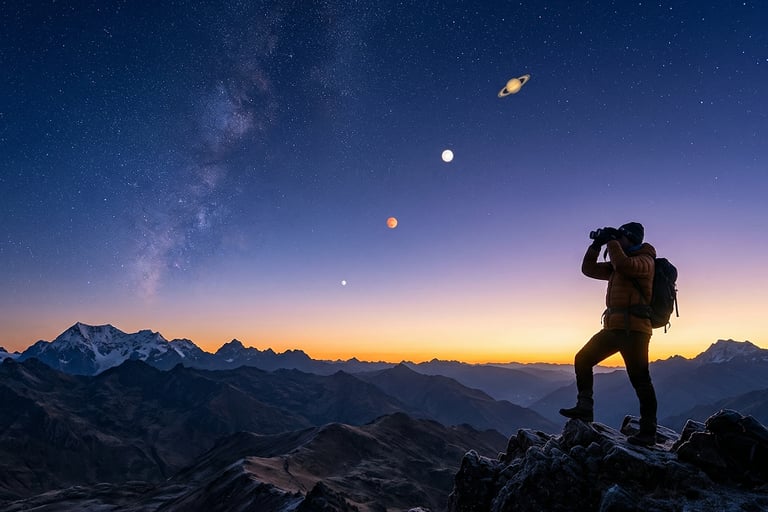
Saturn: Usually the highest in the line, Saturn shines with a steady, yellowish-gold light. Even with modest binoculars, you can perceive its slightly "oval" shape due to its magnificent ring system.
Mars: The "Red Planet" is unmistakable. Look for a steady, ruddy-orange point of light that doesn't twinkle as much as the surrounding stars.
Mercury: This is the most elusive member. It sits closest to the horizon and is only visible for a short window before the sun’s glare swallows it. It appears as a bright, white spark.
Neptune: Unlike the others, Neptune is a "telescopic" planet. You will need a good pair of binoculars or a small telescope to see this distant blue ice giant as a tiny, dim, bluish dot.
For travelers who want to see the rings of Saturn or the disc of Mars in high definition, investing in professional-grade optics is a must. We recommend the specialized refractor telescopes available at High Point Scientific for those who want to take their "Noctourism" to the next level.
Photography Tips for the April 2026 Planet Alignment Guide
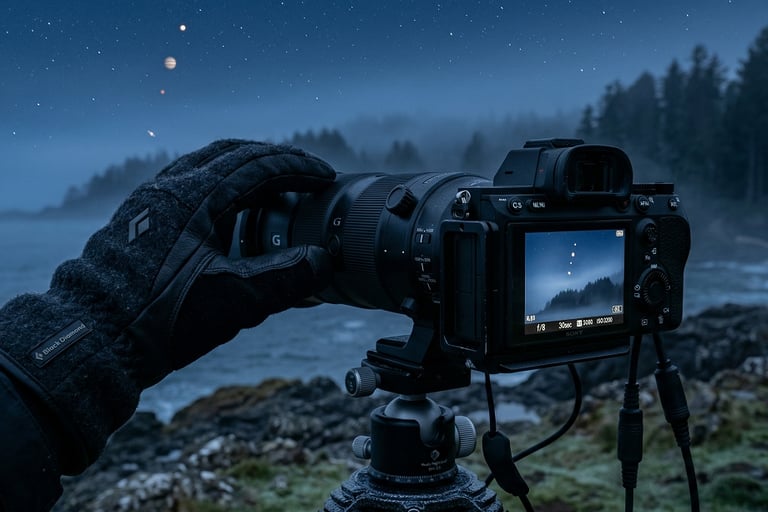
Capturing a planet alignment requires a balance of stability and timing. Because you are shooting in the low light of dawn, a sturdy tripod is non-negotiable.
Set your camera or high-end smartphone to a "Night" or "Manual" mode. For the best results, use a focal length between 24mm and 50mm to capture the entire line of planets along with some of the landscape for scale. An exposure of 5 to 10 seconds at ISO 800 should be enough to capture the planets without causing "star trails" due to the Earth's rotation.
Why This "Planet Parade" Matters in 2026
2026 is proving to be a landmark year for astronomy. As we approach the Solar Maximum, our atmosphere is more active, and the "energy" of the night sky feels palpable. Seeing these four worlds aligned isn't just a coincidence of orbital mechanics; it’s a moment of perspective.
When you stand in the pre-dawn chill and realize that Mercury is currently swinging around the Sun at 100,000 miles per hour, while distant Neptune is nearly 2.8 billion miles away, the "daily grind" begins to feel very small. This is the essence of Lipton Travel: finding the grander story written in the stars.
If you are currently on a trip or planning a morning hike this week, don't miss the chance to look East. The parade won't wait, and the next four-planet alignment of this quality won't occur for several years. For those who want to turn this viewing into a full holiday experience, GetYourGuide offers several "Astro-Photography" workshops in prime dark-sky regions [Placeholder Link: GetYourGuide Astro-Photography Workshops].
Frequently Asked Questions
What time is the planet alignment visible?
The planets are best viewed during the "Civil Twilight" phase, which occurs approximately 45 to 60 minutes before your local sunrise. By 30 minutes before sunrise, Mercury will likely be lost in the morning glow.
Do I need a telescope for the April 2026 alignment?
Mercury, Mars, and Saturn are all visible to the naked eye under clear skies. However, Neptune is much too dim to see without binoculars (at least 10x50) or a telescope.
Where is the best place to see the planet parade?
The "best" place is anywhere with a completely flat eastern horizon. Coastal areas looking over the ocean or high-altitude plateaus are ideal, as buildings or trees will easily block Mercury and Mars.
The Lipton Night Sky Checklist
Identify East: Use a compass app the night before to find your exact viewing line.
Arrival Time: Arrive at your spot at least 75 minutes before sunrise to allow your eyes to adjust and to catch the planets as they rise.
Pack Binoculars: Even if you plan on naked-eye viewing, binoculars will help you "pull" Neptune and Mercury out of the twilight haze.
Check the Weather: Use an app like Astrospheric to check for low-level transparency and "seeing" quality.
Layer Up: Pre-dawn temperatures are often the lowest of the day; wear a windproof outer shell and a warm base layer.
Questions or thoughts? Reach out anytime. Email Mike at info@liptontravelcom
© 2025. All rights reserved.