Comet MAPS 2026 Viewing Guide
COMETS
3 min read
The night sky is currently playing host to a rare celestial visitor that hasn't been seen in over 1,700 years. Comet C/2026 A1 (MAPS) is screaming toward the Sun, and for those of us on Earth, the show is just beginning.
This isn't just any comet; it is a legendary Kreutz sungrazer. Discovered only months ago in January 2026, this fragment of an ancient cosmic giant is putting on a display that has astronomers calling it a contender for the "Great Comet" title.
Whether you are a seasoned astrophotographer or a curious traveler with a pair of binoculars, this Comet MAPS 2026 viewing guide will help you catch this silent traveler before it plunges through the solar corona.
Where to Find Comet MAPS Right Now
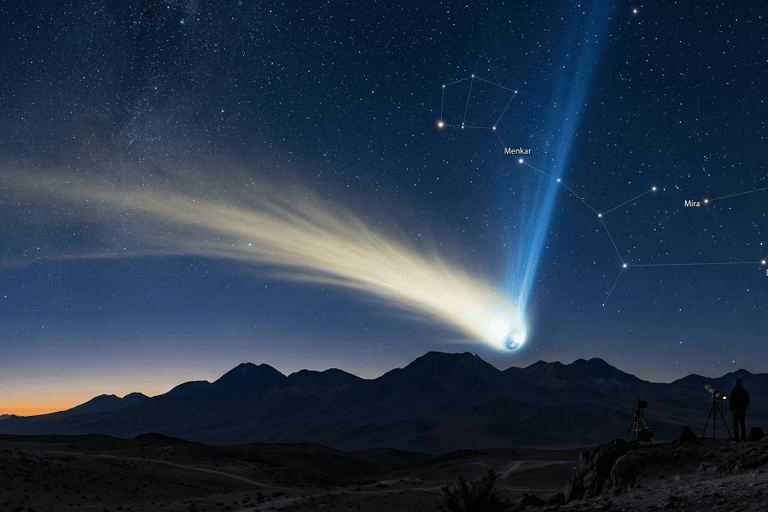
As of late March and early April 2026, the comet is currently located in the constellation Cetus. It is moving rapidly across the sky as it accelerates toward its April 4th perihelion.
For travelers in the Southern Hemisphere, you have the best seat in the house. The comet is currently higher in the sky for you, appearing in the western horizon shortly after sunset.
Observers in the Northern Hemisphere (USA, UK, and Europe) will find the hunt a bit more challenging. You’ll need a perfectly clear southwestern horizon, as the comet is "hugging" the skyline during civil twilight.
The April 4 "Hairpin Turn"
On April 4, 2026, the comet will reach its closest point to the Sun. It will pass just 100,000 miles above the solar surface—a "hairpin turn" that will either vaporize it or ignite its tail into a brilliant, daylight-visible spectacle.
During this 48-hour window, the comet will be lost in the Sun's glare. The best way to "watch" the perihelion safely is via NASA’s SOHO satellite stream.
Essential Gear for the 2026 Peak
While we hope Comet MAPS becomes a naked-eye object by mid-April, right now it is sitting at a magnitude of approximately 7.1. This means you need a little help from technology to see it clearly.
Binoculars: A pair of 10x50 wide-field binoculars is the "sweet spot" for comet hunting. It allows you to see the diffuse "coma" (the comet's head) and the start of the tail.
Small Telescopes: If you have an 80mm to 150mm refractor, you can start to resolve the structure within the tail.
Tripod & Camera: Even a modern smartphone on a stable tripod can capture the comet using "Night Mode" with a 10-second exposure.
If you’re looking to upgrade your setup for the post-perihelion show, we recommend checking out the curated selection at High Point Scientific.
Planning for the Post-Perihelion "Easter Show"
If the nucleus of Comet MAPS survives its fiery brush with the Sun on April 4, the real show begins between April 8 and April 15.
During this week, the comet will emerge into the evening sky, potentially shining as bright as the planet Venus (Magnitude -4). Use Venus as your guide: look to the lower left of the brilliant "Evening Star" in the western sky about 45 minutes after sunset.
For those looking for a guided experience, several specialized "Astro-Tours" are currently operating in high-altitude regions like the Canary Islands and the Andes. You can find last-minute bookings via Viator
Frequently Asked Questions
Is Comet MAPS visible to the naked eye?
As of late March, it requires binoculars or a telescope. However, if it survives its solar flyby on April 4, it is predicted to become visible to the naked eye by April 8, 2026.
What is the best time of day to see Comet C/2026 A1?
The best time is during evening twilight, roughly 30 to 60 minutes after the Sun has set. Look toward the western or southwestern horizon.
Can I see the comet from the city?
Light pollution will significantly wash out the comet's tail. For the best experience, use a "Dark Sky Map" to find a location at least 30 miles away from major city lights.
The Lipton Night Sky Checklist
Check the Weather: Use a dedicated clear-sky app like Astrospheric to ensure no cloud cover.
Find a "Low" Horizon: Scout a location with no trees or buildings to the West/Southwest.
Let Your Eyes Adapt: Avoid looking at your phone for 15 minutes before observing to allow your "night vision" to kick in.
[Locate Venus: Use the brightest object in the sky as your starting point for the hunt.
Pack the Layers: Even in spring, dark-sky sites get cold quickly. Dress for 10 degrees colder than the forecast.
Questions or thoughts? Reach out anytime. Email Mike at info@liptontravelcom
© 2025. All rights reserved.